SocialMaharaj Technology, Travel, Food et al
Related Articles

Ever since I can remember, red torii gates have had a hold on me. Every documentary, every travel show, every friend’s Japan photo dump – there’d always be one shot of a vermillion gate against green forest or grey stone, and I’d think, I need to stand under one of these someday. So when I finally started planning my first trip to Japan, visiting temples and shrines in Tokyo wasn’t optional; it was the whole point.
I’d already written about getting my Suica card sorted, and once that was tapped and working, Tokyo’s metro turned into my temple-hopping machine for a few days before I boarded the Shinkansen to Kyoto. That’s the context for this post – a few very good days in Tokyo, spent almost entirely chasing shrines and temples.
In this blog post, I’ll walk you through the temples and shrines in Tokyo I actually visited – Sensoji in Asakusa, Hanazono Shrine in Shinjuku, and Meiji Jingu – along with the history behind each, how I got there, the architecture, and a few customs I tried myself. But before that, a quick primer, because I went in mixing up two very different things.
Buddhist Temples vs Shinto Shrines
Before this trip, I used “temple” and “shrine” interchangeably. Big mistake. Japan has two distinct religious traditions living side by side, often within walking distance of each other, and once you know what to look for, telling them apart is genuinely easy.
Buddhist temples (o-tera) house Buddhist deities and are usually run by monks. You’ll spot them by a sanmon gate (a large wooden gate, sometimes with guardian statues on either side), incense burners, and often a pagoda somewhere in the complex. Sensoji, which I’ll get to, is a temple.
Shinto shrines (jinja) are rooted in Japan’s indigenous faith, Shinto, which centres on kami – spirits or gods present in nature, objects, and even people. Shrines are marked by a torii gate at the entrance, a purification fountain (temizuya) where you rinse your hands and mouth before approaching, and a main hall where you offer a coin, bow, clap, and pray. Hanazono Shrine and Meiji Jingu are both shrines.
The simplest tell, honestly, is the gate. A torii means shrine. A heavier wooden sanmon, often guarded by statues, means temple. Once that clicked for me, the rest of the trip made a lot more sense.
The Significance of Torii Gates
A torii marks the boundary between the ordinary world and sacred ground. Walk through one, and you’re technically no longer in the mundane world – you’re stepping into the space of the kami. That’s part of why you’re meant to walk along the sides of the path leading up to a shrine rather than straight down the middle – the centre is considered the path of the god, not the visitor.
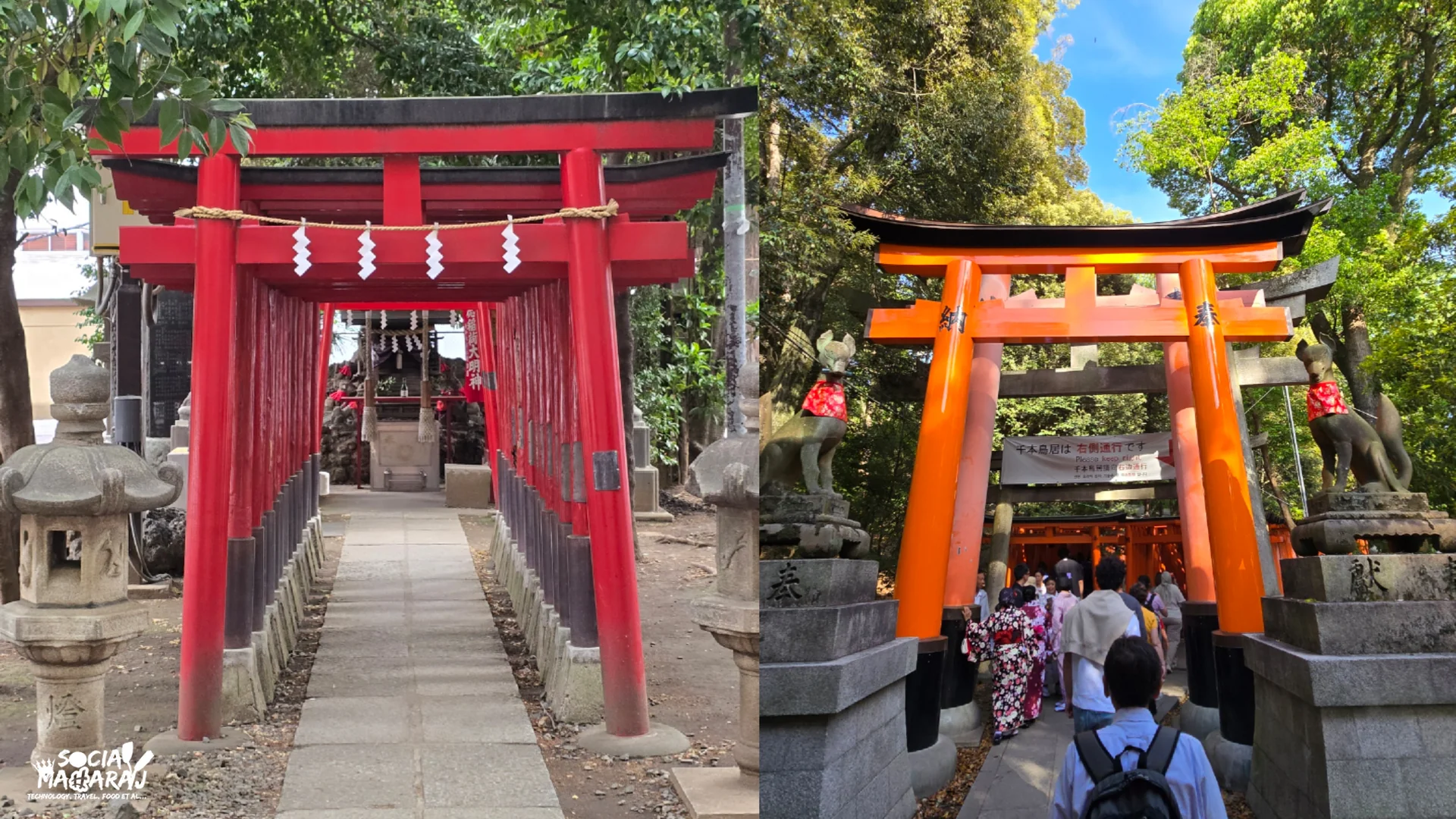
The vermillion red most torii are painted in isn’t just decorative either. Traditionally, the colour was believed to ward off evil and misfortune, and practically, the mercury-based pigment used historically also helped preserve the wood. So the gates are red for both a spiritual and a very practical reason, which is a combination I found strangely satisfying to learn.
Once I knew this, I started noticing torii everywhere in Tokyo – tucked between office buildings, at the end of alleys, guarding tiny neighbourhood shrines I’d have otherwise walked straight past.
Temples and Shrines in Tokyo I Visited
I didn’t try to cover all the temples and shrines in Tokyo – that would need weeks, not days. I picked three that were either unmissable or conveniently close to where I was staying, and each one turned out to have its own personality:
- Sensoji, Asakusa – Tokyo’s oldest temple, reached by metro from Shinjuku
- Hanazono Shrine, Shinjuku – a quiet shrine a short walk from my hostel
- Meiji Jingu – a forested escape near Harajuku, reached by metro and a walk
Sensoji, Asakusa
Sensoji wasn’t the first stop on my trip, I visited it on my 3rd day in Tokyo because I knew the temple deserved time. It’s not only one of the most popular temples in the city, but is also the most visited religious site in the entire world, pulling in around 30 million visitors a year. It’s touristy, yes, but it’s also genuinely, actively used by locals for worship – crowds and quiet devotion sharing the same courtyard, which is a combination I didn’t expect.
History
Sensoji is Tokyo’s oldest temple, and by some distance. Legend has it that in 628 AD, two fishermen brothers pulled a small statue of Kannon, the Buddhist goddess of mercy, out of the Sumida River. The temple itself was formally established in 645 AD to enshrine it, and the current structures date back further than most of Tokyo, having been rebuilt after WWII bombing destroyed the originals.
How to Get There
I went by metro from Shinjuku. The most direct route is the Marunouchi Line to Ginza (about 20 minutes), then a transfer to the Ginza Line to Asakusa (about 10 minutes) – roughly 35 minutes total, for around ¥260. Take Exit 1 at Asakusa Station, and it’s a 5-minute walk straight to Kaminarimon.
Architecture
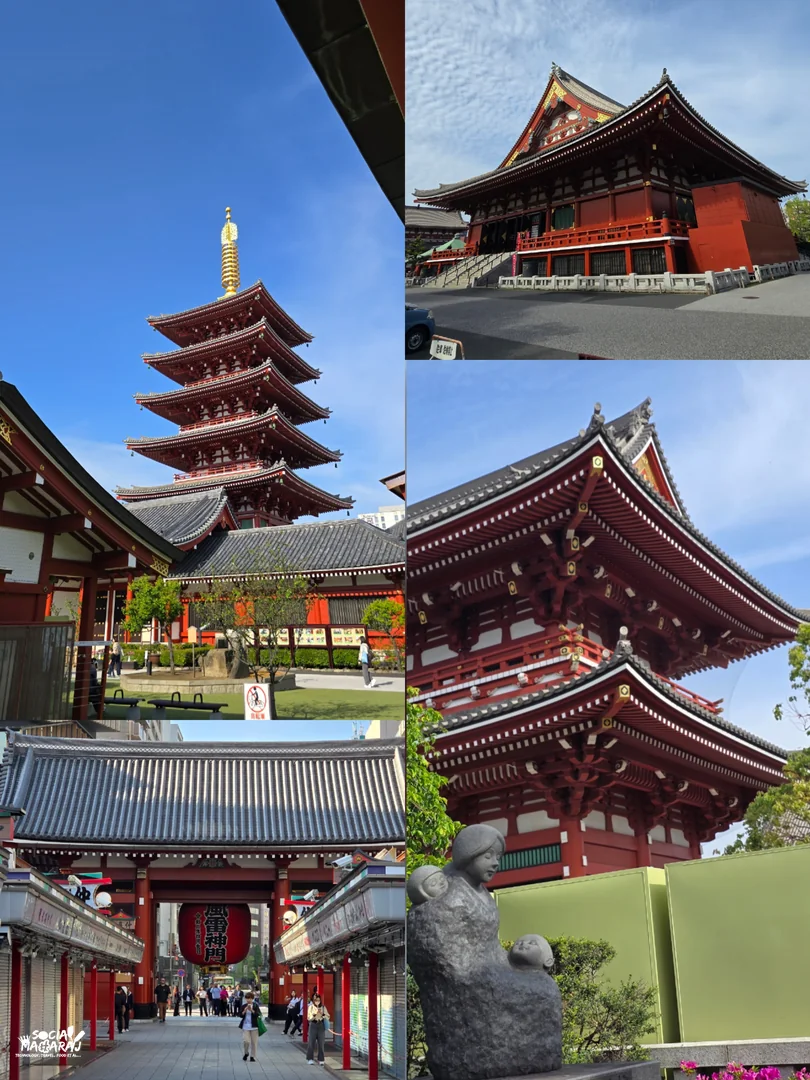
You enter through Kaminarimon, the “Thunder Gate”, instantly recognisable by the giant red lantern hanging in its centre. Past the gate is Nakamise-dori, a shopping street packed with stalls selling snacks and souvenirs, which leads you straight to the main hall.
Off to one side stands a striking five-storey pagoda, and the whole complex has that layered, unhurried feel of a place that’s been added to over centuries rather than built in one go.
Customs
Just inside the main hall, I tried omikuji (fortune drawing) for the first time – you shake a metal box until a numbered stick falls out, then match the number to a drawer holding your fortune. If you draw a bad one, tradition says you tie it to a nearby rack instead of taking it home, essentially leaving the bad luck behind at the temple. I’m not going to say what I drew, but I did tie it up.
Hanazono Shrine, Shinjuku
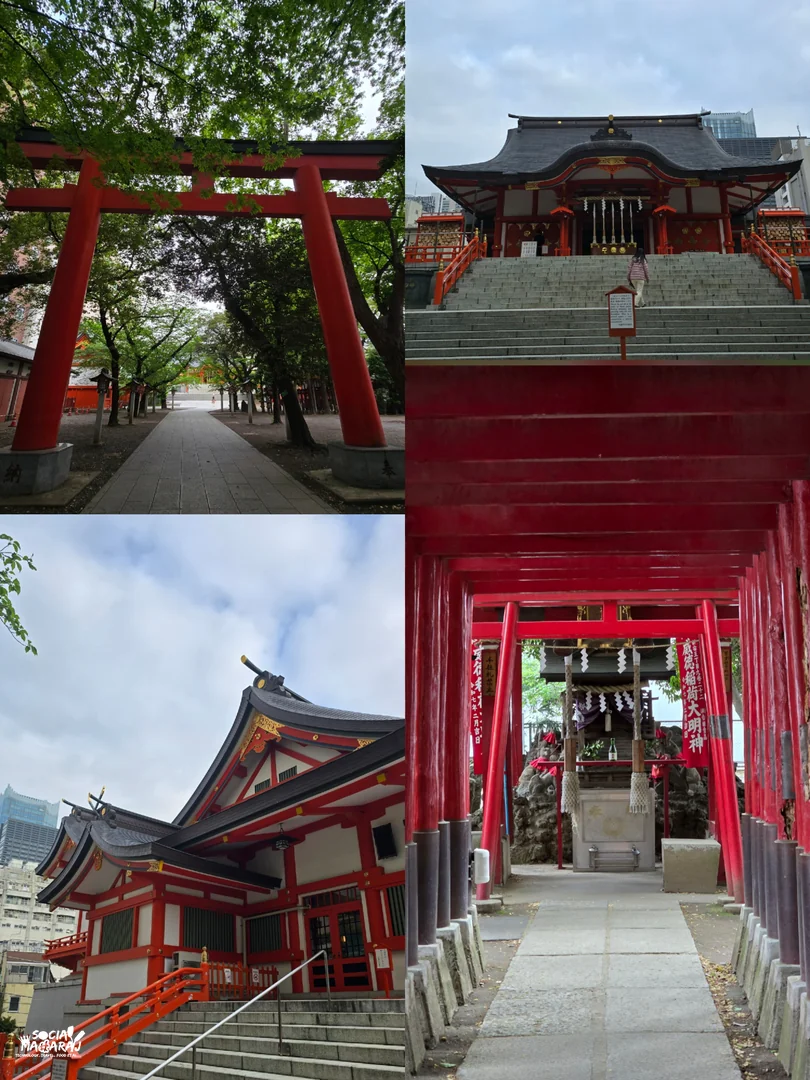
Hanazono was the easiest of the three, and also the biggest contrast – a shrine sitting almost absurdly close to Shinjuku’s busiest streets, including the nightlife alleys of Golden Gai, without losing an ounce of its calm. In fact it was on the way to my hostel and being fascinated by red torri gates, I just walked into it on the first day I landed in Tokyo.
History
Hanazono Shrine was founded in the mid-1600s, long before Shinjuku became Shinjuku. It’s specifically an Inari shrine – dedicated to Inari, the Shinto deity of rice, commerce, and prosperity – which is exactly why it’s become the go-to shrine for Shinjuku’s business crowd praying for successful ventures. The commerce connection isn’t a vague association; it’s the actual point of the deity it’s built for.
How to Get There
This one I walked to, since it was close to my hostel in Shinjuku. If you’re relying on the trains instead, the nearest station is Shinjuku-Sanchome – the shrine is literally seconds from Exit E2. From Shinjuku Station’s east exit, it’s about a 7-minute walk.
Architecture
A row of vermillion torii leads into a compact but well-kept grounds, with the main shrine building set back from the entrance. Unlike Meiji Jingu’s sprawling forest, Hanazono is small and self-contained, almost squeezed between buildings, which somehow contrasts with the city outside feel even sharper.
Meiji Jingu
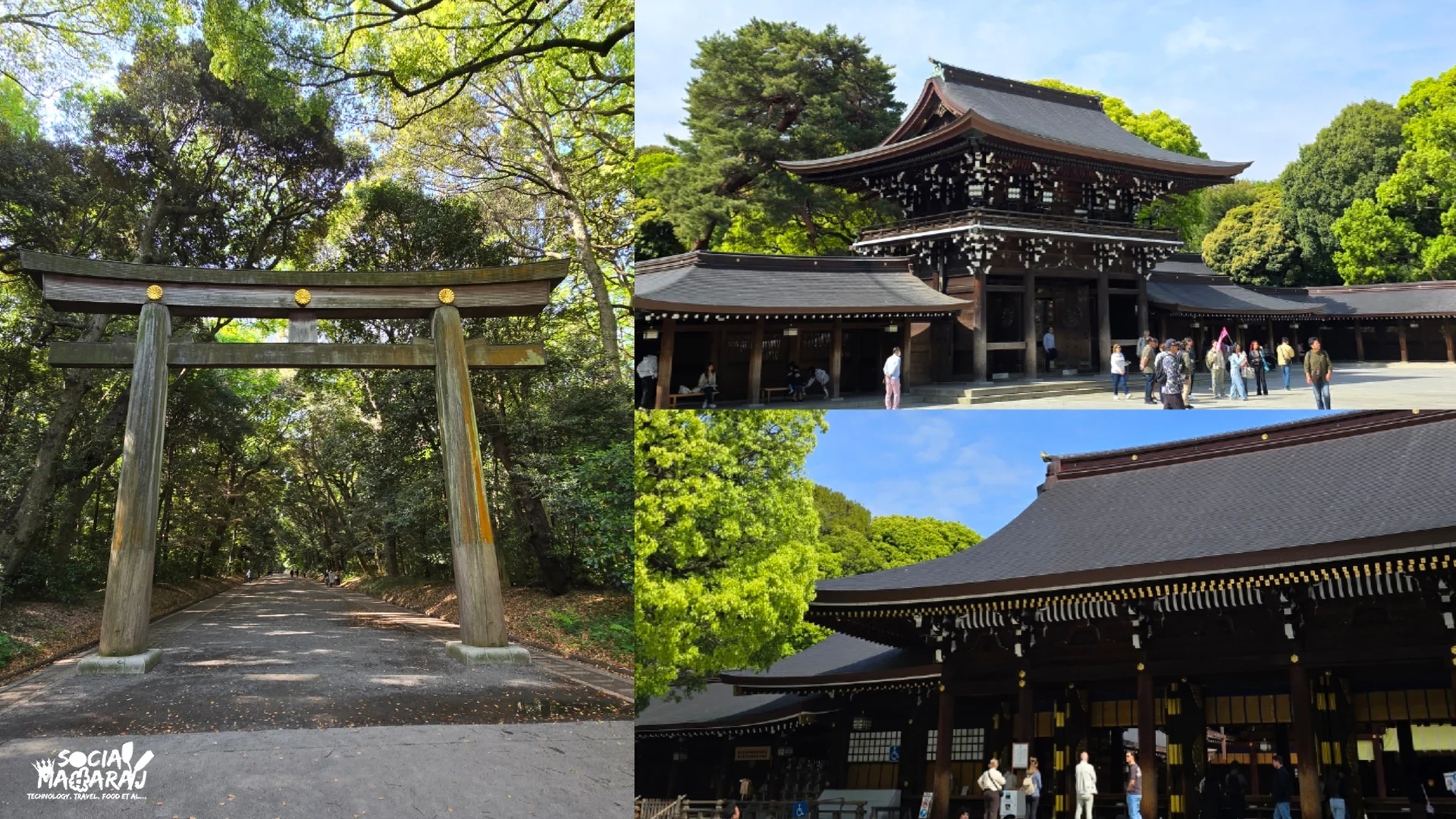
Meiji Jingu was the last of the three, and the one that stuck with me the most. It’s one of Tokyo’s most significant Shinto shrines, and by the time I reached the main complex, Harajuku’s crowds felt like they belonged to a different city entirely.
History
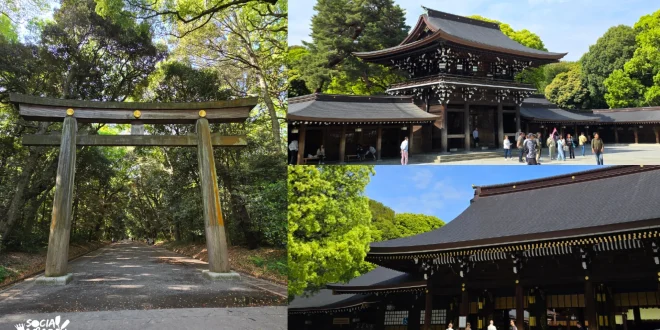
Meiji Jingu was completed in 1920, dedicated to Emperor Meiji and Empress Shoken, whose reign pulled Japan into the modern era. What makes it remarkable isn’t just the shrine itself but the forest around it – over 100,000 trees, donated from across Japan when the shrine was built, now grown into a dense, genuinely wild-feeling forest right in the middle of Tokyo.
How to Get There
I took the JR Yamanote Line to Harajuku Station (the Chiyoda or Fukutoshin Metro lines to Meiji-jingumae Station work just as well). From Harajuku, you walk in through the South Approach, lined with ginkgo trees, and it takes about 10 minutes on foot to reach the main shrine. Don’t rush this part – the walk itself is designed to slowly strip away the city before you arrive.
Architecture
The entrance torii is enormous, made of Japanese cypress, and it sets the scale for everything that follows. Along the path, I passed rows of wine barrels – Burgundy wine barrels donated by French vintners, standing opposite traditional sake barrels (kazaridaru) donated by Japanese brewers. It’s a small, deliberate detail that speaks to the exchange between Japan and the West that Emperor Meiji’s reign represented, and it’s not something I expected to see at a shrine.
Further along, wooden placards displayed waka poems written by Emperor Meiji and Empress Shoken themselves – short, personal verses, translated into English alongside the original. Reading an emperor’s actual poetry on a walk through his memorial forest is a strange, quiet kind of moment, and I stood there longer than I expected to.
Customs
Near the main shrine, I came across a wish-writing custom – you write your wish on a piece of paper, seal it in an envelope along with a small monetary offering, and drop it into a designated box. Unlike the wooden ema plaques you see hung up at other shrines, this one felt more private, more like a sealed letter than a public wish board. I wrote mine, dropped it in, and left without needing to know if anyone would ever read it. That felt like the point.
Finding Peace at Temples and Shrines in Tokyo
Three temples and shrines in a handful of days barely scratches the surface – Tokyo has hundreds more I didn’t get to, tucked into neighbourhoods I never even walked through. But that’s not really a complaint. It just means there’s a reason to go back.
What stayed with me more than any single temple was how consistently peaceful every one of them felt, regardless of how busy the streets outside were. Sensoji was crowded by the tie I left, and Hanazono was tiny, and Meiji Jingu was enormous, and somehow all three gave me the same quiet, unhurried feeling the second I stepped past the gate. In a city that moves as fast as Tokyo does, that’s not a small thing.
If you’re heading to Tokyo and wondering whether temple-hopping is worth carving time out for between the neon and the ramen, it is. Start with these three if you’re short on time, then let yourself get distracted by whichever torii gate you spot next.
Have you been to any of these temples and shrines in Tokyo, or do you have a favourite I should add to the list for next time? Drop a comment below, tweet to me at @Atulmaharaj, DM on Instagram, or Get In Touch.