SocialMaharaj Technology, Travel, Food et al
Related Articles

2026 has started on a good yet nostalgic note for me. God knows for what reason, but I’ve been revisiting places that I had visited as a school kid during my days at New Era High School. Back in the day, it was just another educational trip when nothing made sense and it was all about getting out of the hostel. This time, I was more aware and just in awe of what mankind was able to achieve, even without ChatGPT.
In my previous post, I wrote about my road trip from Hyderabad to Badami when I visited the beautiful sites of Badami Cave Temples, Pattadakal and Aihole – for the 3rd time – with family for the first time and was once again in awe of the beautiful temples I saw.
The moment I saw the rust-red sandstone cliffs rising majestically above the shimmering Agastya Lake, I knew I had reached a special place – and the school memories came gushing in! Badami was the highlight of this journey, because it was my first visit since school – the final jewel in the crown of the UNESCO heritage circuit that includes Aihole and Pattadakal.
In this blog post, I’ll take you through my entire experience visiting the Badami Cave Temples, one of India’s oldest dated cave temples, from their rich history and stunning architecture to practical tips for your visit. So buckle up for a deep dive into this spectacular piece of Indian heritage.
The History of Badami and the Chalukya Dynasty
Before I talk about the caves themselves, let me take you through the fascinating history of Badami, formerly known as Vatapi, which was the capital of the early Chalukya dynasty from roughly 540 to 757 CE. It was the nerve centre of one of the most innovative and powerful kingdoms in early medieval India.
Pulakeshin I, the founder of the dynasty, established Badami as his capital sometime between 535 and 566 CE, choosing this site strategically. The sandstone cliffs rise sharply on three sides, creating a natural fortification that was perfect for defense. The Malaprabha valley, with its fertile lands and water from the Agastya Lake, made this location ideal for a capital. It was here that the Chalukyas began to transform the landscape into a cradle of temple architecture.
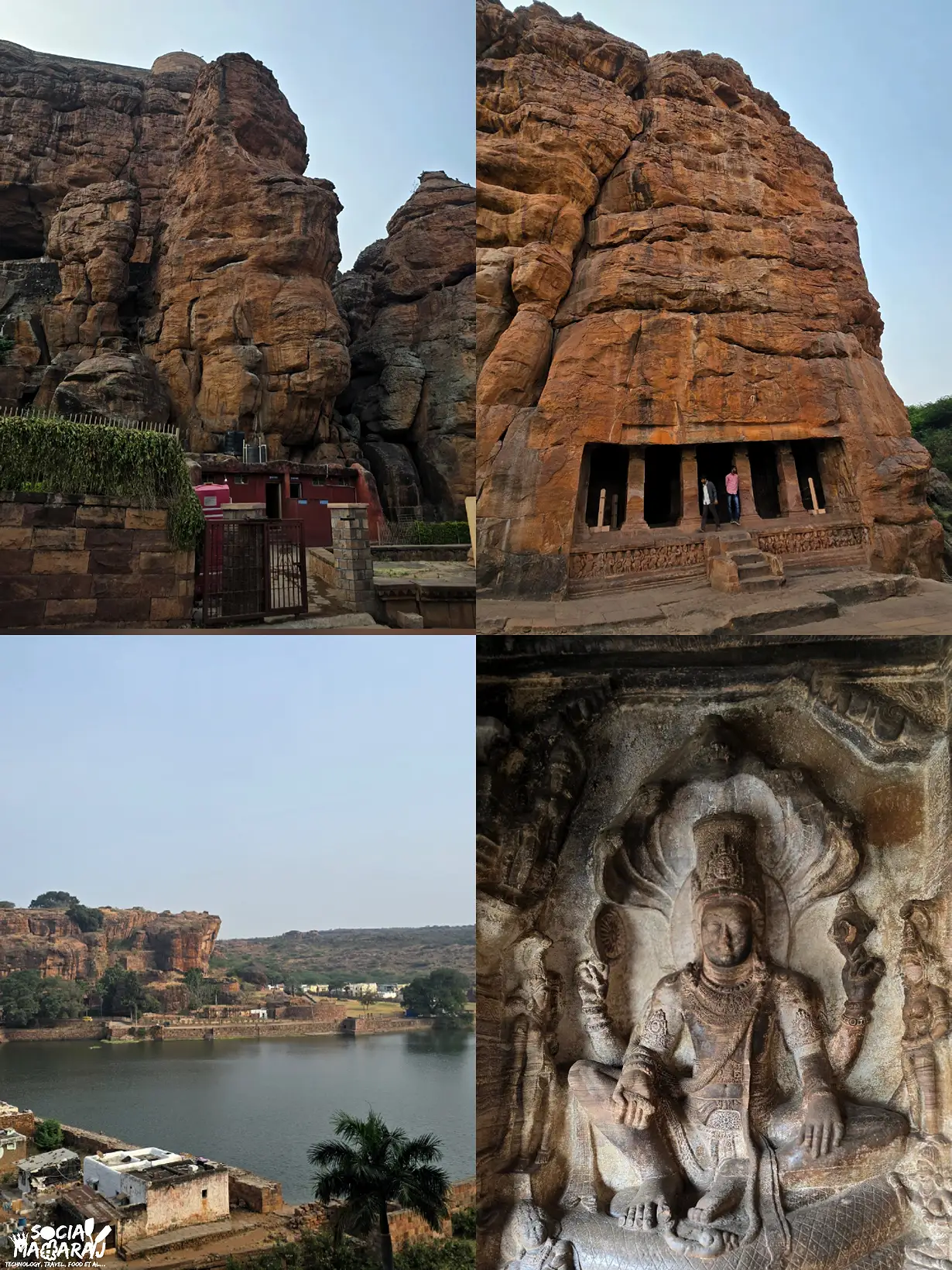
One of the most important historical markers here is the inscription found in Cave 3, dated to 578-579 CE. This inscription, written in Old Kannada, makes Cave 3 the oldest firmly-dated Hindu cave temple in India, a remarkable fact that adds immense historical value to the site.
Today, the Badami Cave Temples form the last piece in the tentative list of UNESCO World Heritage Site candidate titled “Evolution of Temple Architecture – Aihole-Badami-Pattadakal.” If you want to dive deeper into this fascinating history, I highly recommend reading about Aihole, the cradle of temple architecture and Pattadakal’s magnificent temples, two other incredible stops on this heritage circuit.
Reaching Badami Cave Temples – Entry, Facilities & First Impressions
Since we were staying in Almatti, we were about 70 km (~2 hours) away from Badami, and we decided to leave our hotel by 7 AM. We arrived here by 9 AM, and reached the spot by 9:30/10 after having a quick breakfast at Udupi Shree Banashree restaurant. Located in the Bagalkot District of Karnataka, Badami is about 22 ks from Pattadakal and 35 km from Aihole, making it very convenient to cover all three in a well-planned itinerary.
Parking is a little tricky. I mean, while there is some parking at the start of the place, I was told that the roads to the temple are closed at 10 AM and cars are not allowed to enter. Not sure if I was scammed or what, but I was like, okay. So we parked the car near the main road, and bargained for an auto for ₹400 to take us to the cave temples, the Agastya Lake and the Bhoothnath temple – for 3 adults, this seemed like a good deal. Parking was free because we took the auto.
The entry fee was a reasonable ₹25 for Indian nationals. You can save ₹5 by booking online via the QR code at the ticket counter, which I found quite handy. The facilities on site were fairly basic but clean: fresh drinking water points and well-maintained washrooms made the visit comfortable. Lots of monkeys are there, so please take care of your belongings.
We wanted to hire a guide but couldn’t find anyone. The other tourists that we saw had guides with them, but we’re not sure how they found them.
Also, my parents climbed the stairs only till Cave 1 – I’m glad they climbed there at least. So they sat there for an hourish as I went to all the caves and came back.
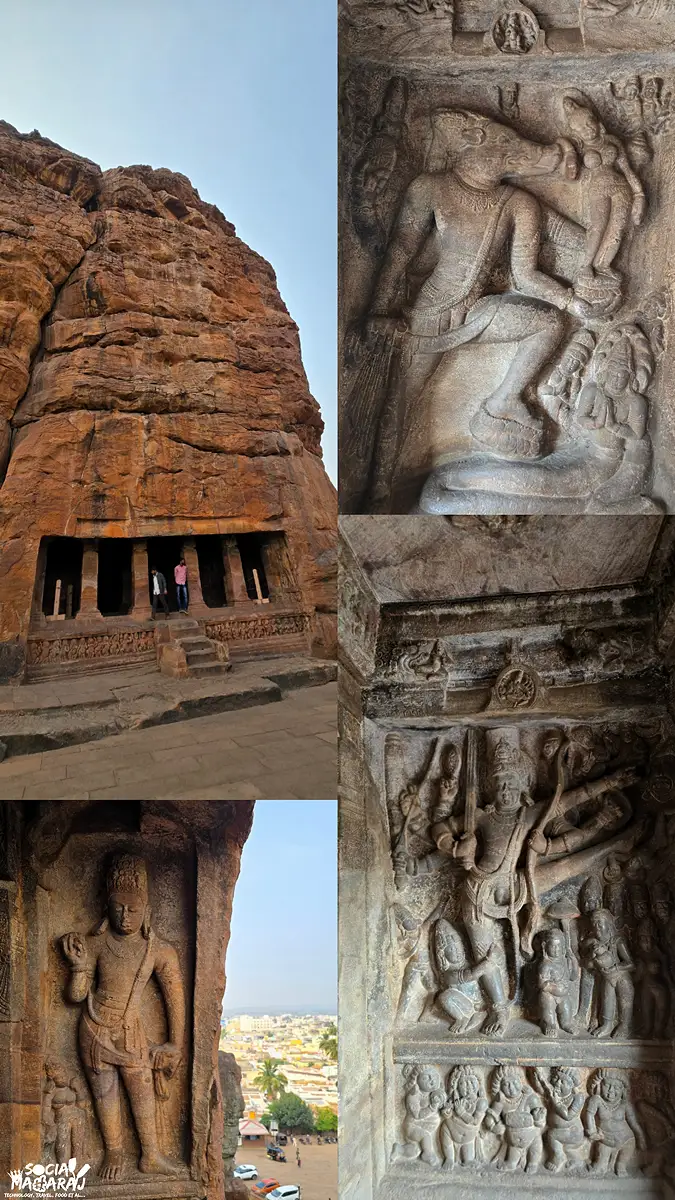
Cave 1 – The Shiva Temple with 18-Armed Nataraja
Climbing about 40 to 50 steps from the ground level brought me to Cave 1, dedicated to Lord Shiva. This was my first intimate encounter with the exquisite sculptures and architecture of Badami, and I was immediately struck by the richness of detail – back during my educational trip, it was just another cave!
The main attraction here is the magnificent 18-armed Nataraja, the cosmic dancer, depicted in 81 dance poses from the classical Bharata Natya tradition. This sculpture is a masterpiece of both artistic vision and spiritual symbolism. Standing before it, I felt a deep sense of awe, the complexity of the poses and the serene expression on Shiva’s face spoke volumes about the skill of the Chalukya artisans.
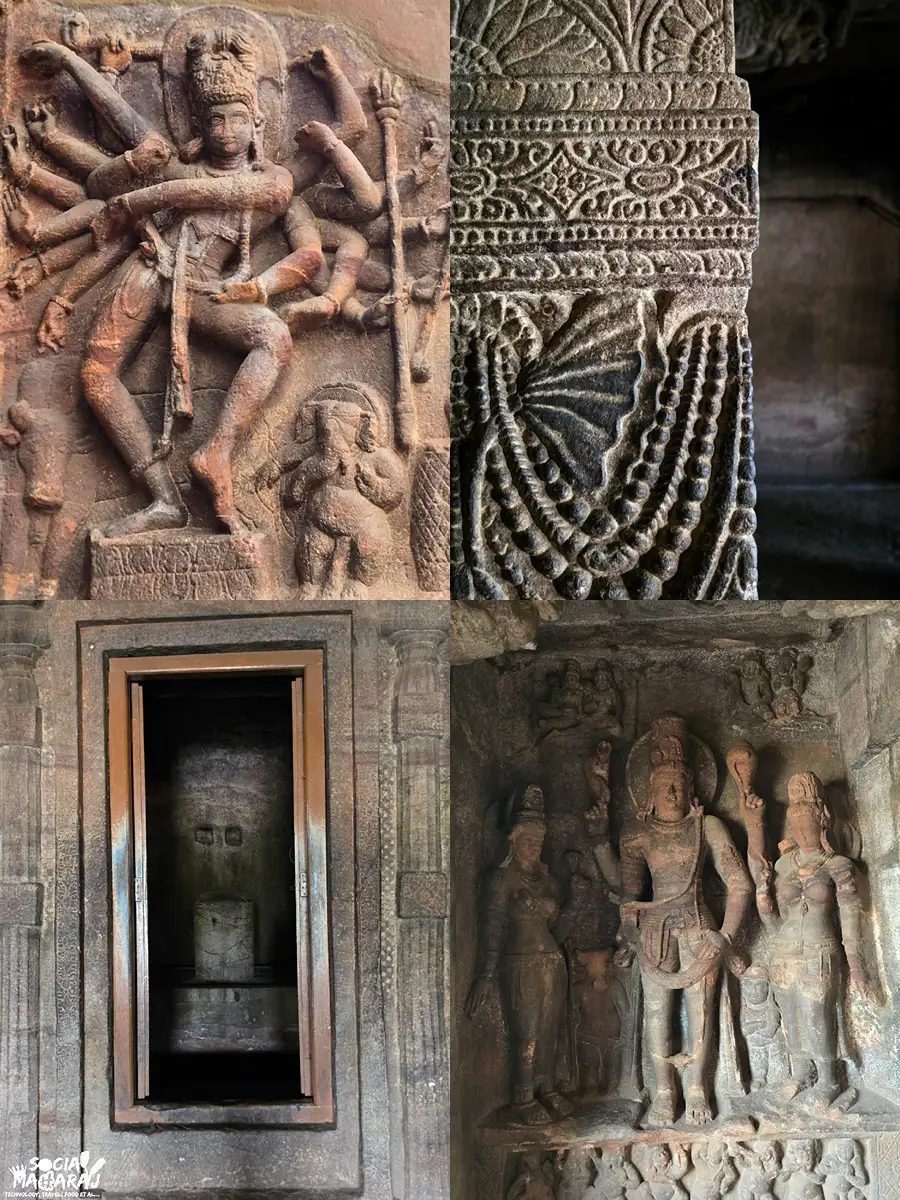
Beyond Nataraja, several other key sculptures caught my eye. Ardhanarishvara, the half-Shiva, half-Parvati composite, beautifully symbolises the unity of masculine and feminine energies. Nearby is Harihara, a composite figure merging Shiva and Vishnu, representing the harmony of different Hindu traditions.
The fierce but graceful Mahishasura Mardini, Durga slaying the buffalo demon, is another highlight, carved with dynamic energy and narrative power.
Looking up, the ceiling features the five-hooded Nagaraja, the serpent king, surrounded by celestial couples. This adds an ethereal quality to the space, making it feel like a cosmic dance hall.
The pillars are intricately carved with scenes from Parvati’s marriage to Shiva, adding layers of storytelling to the temple’s architecture.
The temple follows a classic structure: the mukha mantapa (entrance hall) leads into the maha mantapa (main hall) and finally the garbha griha (sanctum sanctorum), which houses the Shiva Linga, the aniconic representation of Shiva.
Cave 2 – The Vishnu Temple
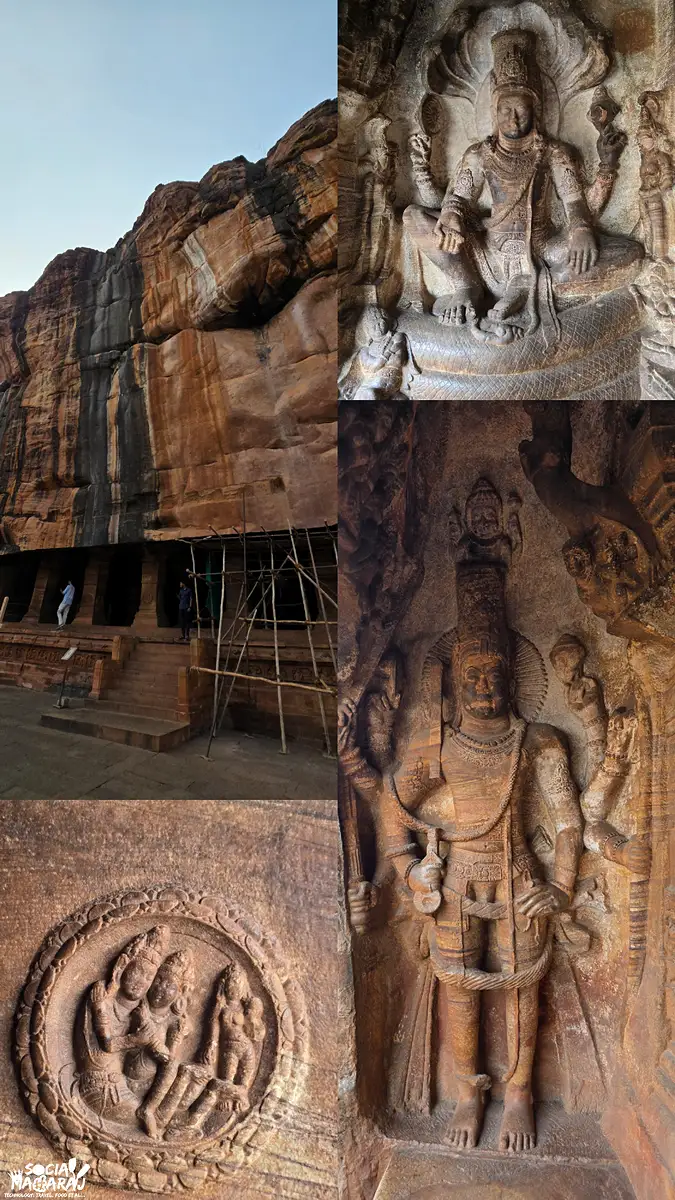
From Cave 1, I climbed about 60 more steps to reach Cave 2, dedicated to Lord Vishnu. The floor plan here mirrors Cave 1, with a verandah leading to the main hall and shrine, but the thematic focus shifts entirely.
The sculptures here celebrate Vishnu’s various avatars, showcasing the rich history of Hindu mythology. The Trivikrama avatar, where Vishnu takes three giant steps to reclaim the universe, is prominently featured. The Varaha avatar, in which Vishnu rescues the Earth in the form of a boar, is another striking sculpture. I was especially impressed by the friezes depicting stories from the Bhagavata Purana, carved with delicate detail and expressive figures.
One of the most dramatic scenes is the Samudra Manthan, the churning of the cosmic ocean, depicted on the walls, capturing the tension and excitement of this legendary event.
The four pillars in the verandah are adorned with Yali carvings, mythical lion-like creatures that add a powerful protective aura to the space.
Compared to Cave 1, Cave 2 feels slightly less crowded with sculptures but offers a serene and contemplative atmosphere. The craftsmanship across both caves is exceptional, revealing the Chalukyas’ mastery in sculpting both narrative and symbolic forms.
Cave 3 – The Crown Jewel of Badami
Cave 3 is the largest and most significant cave temple at Badami. I had to climb another 60 steps beyond Cave 2 to reach this expansive space, but every step was worth it.
Dating back to 578-579 CE, Cave 3 is dedicated by Mangalesha himself, as evidenced by the Old Kannada inscription carved into the rock. This makes it the oldest firmly-dated Hindu cave temple in India, a fact that blew my mind.
The front elevation spans about 70 feet, and inside, the temple blends Shaivite and Vaishnavite themes, making it a hybrid masterpiece. The sculptures of Lord Vishnu dominate here, with giant, imposing figures of Vishnu seated on the coiled serpent Ananta Shesha, the fierce Narasimha avatar tearing apart the demon Hiranyakashipu, the Varaha avatar lifting the Earth, the Trivikrama, and the composite Harihara.
The ceiling and pillar carvings are the most ornate of all the caves, featuring delicate lotus motifs, geometric patterns, and traces of ancient frescoes hinting at the temple’s vibrant past.
My personal favourite was the Narasimha sculpture: the raw power and emotion captured in stone is awe-inspiring.
I spent nearly 45 minutes here, soaking in the artistry and the panoramic views of Badami town and Agastya Lake from this elevated vantage point – also catching up on my breath! The combination of natural beauty and architectural grandeur makes Cave 3 the best-preserved and most detailed of the four.
Cave 4 – The Jain Temple
Just 10 steps east from Cave 3 lies the smallest of the four caves, Cave 4, dedicated to Jainism. This cave stands out not just for its religious significance but also because it was built later, possibly completed in the 11th century under the Kalyani Chalukyas, who succeeded the early Chalukyas.
Inside, the key sculptures include Lord Mahavira, the 24th Tirthankara, depicted sitting serenely on a pedestal. Parshvanatha and Bahubali, other important Tirthankaras, are also carved here, alongside various smaller figures.
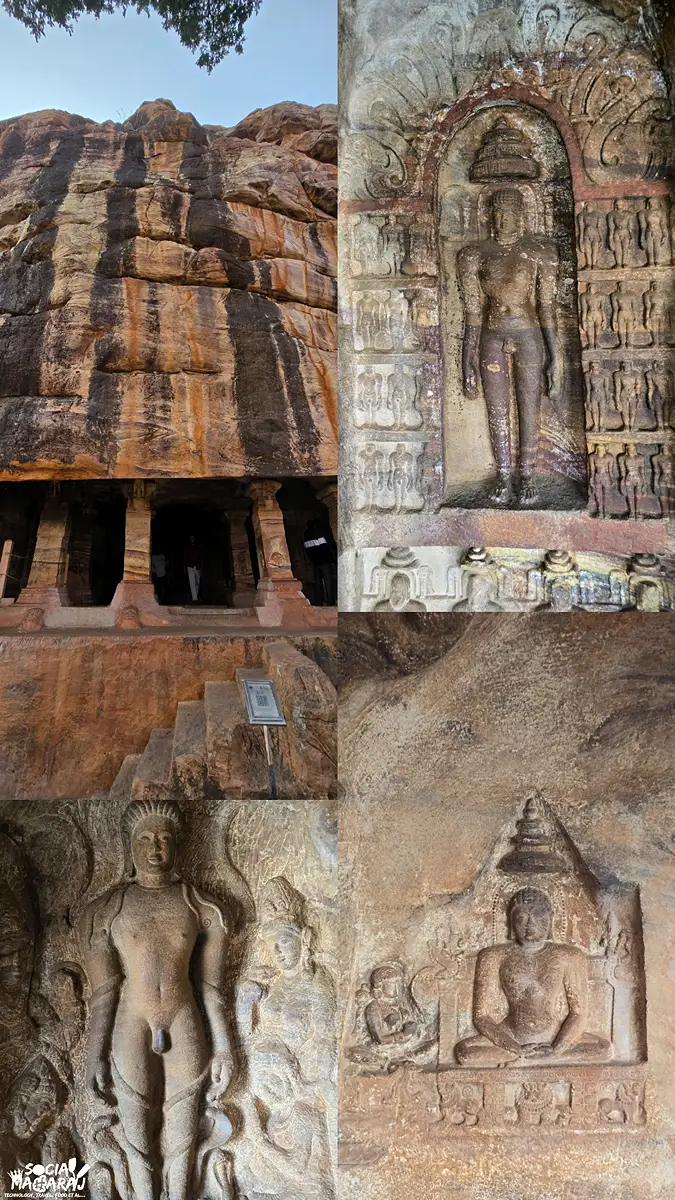
The interior pillars are decorated with carvings of all 24 Jain Tirthankaras, reflecting the religious harmony of the era. Several 12th-century Kannada inscriptions further attest to the cave’s historical significance.
Architecturally, Cave 4 is simpler and less ornate compared to the Hindu caves, emphasising spiritual austerity and calm over dramatic storytelling. This contrast was quite striking and gave me a sense of the pluralistic ethos that existed during the Chalukya period.
By the time I had explored all four caves, I had climbed roughly 190 to 200 steps, a moderate workout, but well worth it for the incredible history and artistry.
Agastya Lake and Bhootanaatha Temple Complex
It took just over an hour for me to cover all the temples and get back to the base and reunite with my parents. Our auto was there, so we drove to the next stop, the Agastya lake and the Bhootanaatha temple.
Below the cliffs and caves lies the tranquil Agastya Tirtha, also called Agastya Lake, a man-made reservoir created by the Chalukyas using an earthen dam to harness and channel the Malaprabha River’s waters.
From the caves, looking down at the shimmering lake was a beautiful sight, especially with the rust-red cliffs framing the water.
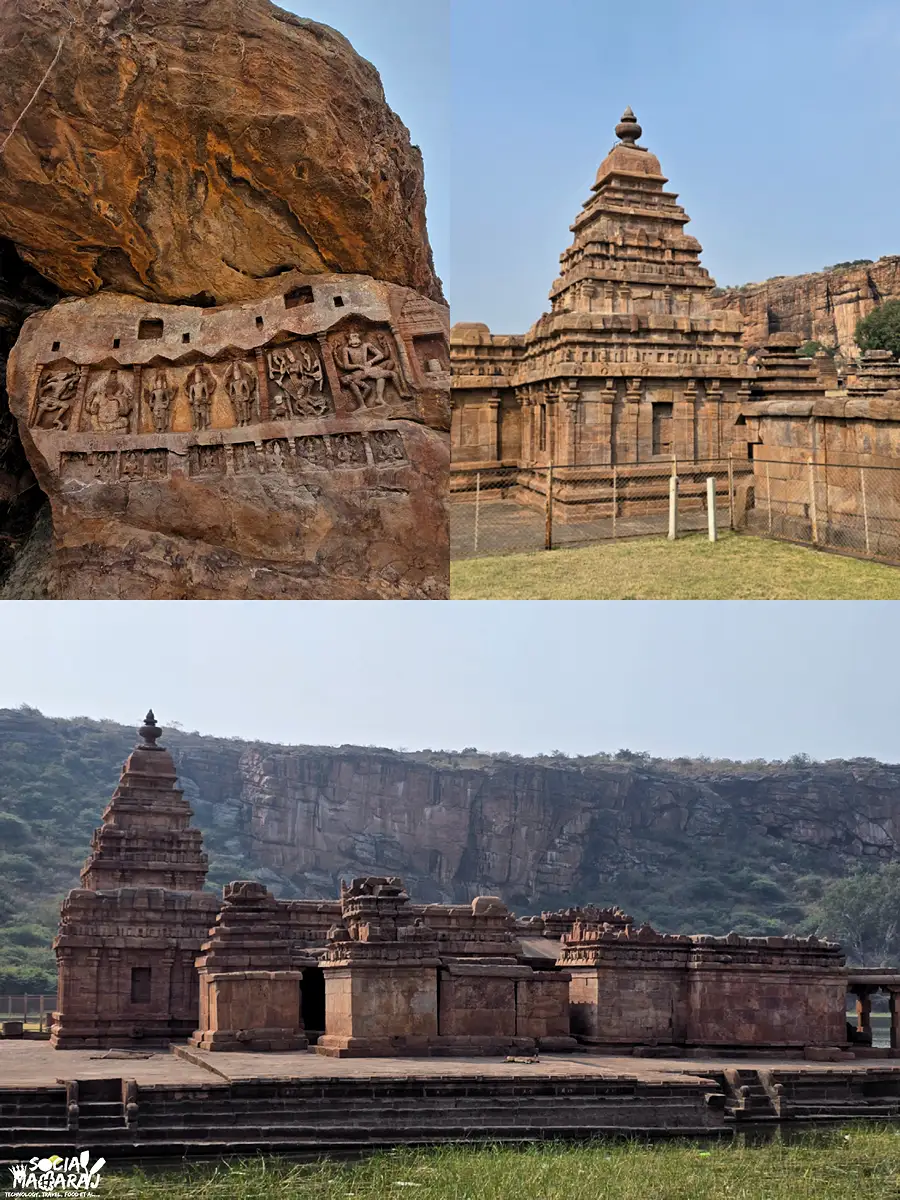
On the lake’s edge is the Bhootanaatha Temple complex, dedicated to Shiva as the god of souls and spirits. The temple was constructed in stages, with the base dating back to the 7th century and subsequent additions made in the 11th century. Unlike the cave temples, Bhutanatha remains an active temple complex, with devotees still visiting regularly.
The temple complex is again very serene and calm, with some beautiful views of the cave temples. The temple complex houses an idol of Nandi and a Shiv ling, among others. But the highlight for me was the carvings of all the avatars on the rock next to the main temple – I just cannot talk about it! Moreover, my parents instantly recognising all of them was astonishing!
Badami vs Pattadakal vs Aihole – Understanding the Difference
Having explored all three sites on this UNESCO heritage circuit, I felt it was important to understand what makes each unique and why visiting all three is a must.
Aihole is the experimental ground. It’s where early architects tested out various forms and styles. The Durga Temple’s apsidal structure, resembling a Buddhist chaitya, stands out as a unique example. Aihole’s sprawling complex has over 125 temples, showcasing diverse ideas in their infancy. You can read more about this in my post on Aihole, the cradle of temple architecture.
Pattadakal, about 22 km from Badami, represents the perfection phase. Here, the Nagara and Dravidian styles were refined and combined in an organised temple town layout. Temples like Virupaksha and Mallikarjuna showcase this architectural maturity. Pattadakal feels more like a living city of temples, with a polished and sophisticated vibe. I’ve detailed this in my piece on Pattadakal’s magnificent temples.
Badami is where cave innovation shines. The rock-cut temples here are masterpieces of carving skill, and the setting amidst cliffs and Agastya Lake makes it visually dramatic. It’s also home to India’s oldest dated cave temple. The natural beauty combined with architectural genius offers a different experience altogether.
While most itineraries and this one would say to cover all of them in a day, since all of them are very close to one another, if I had an option, I’d dedicate half a day at least to each site, if not more. I’ve always wanted to visit Pattadakal in the morning or evening to get good photos, but that hasn’t happened until now, hopefully someday!
For more road trip itineraries from Hyderabad, check out my guide on road trips from Hyderabad where I cover routes including these sites.
Practical Information & Visiting Tips for Badami Cave Temples
Here’s a quick rundown of what you need to know before visiting:
- Timings: Open daily from 9:00 AM to 5:30 PM.
- Entry Fee: ₹25 for Indian nationals, ₹300 for foreign tourists, and free for children below 15 years.
- Time Needed: Allocate at least 2-3 hours to explore all caves thoroughly, plus an additional hour if you plan to visit the Bhutanatha Temple and walk around Agastya Lake.
- Best Time to Visit: October to March offers pleasant weather. Visit early morning (7-9 AM) or late afternoon (4-6 PM) for the best light and cooler temperatures. Avoid the summer months (March-June) due to intense heat.
- What to Carry: Water bottle, comfortable walking shoes, hat or cap for sun protection, your camera, and small snacks (but be cautious of monkeys).
- Nearby Attractions: The Archaeological Museum (check if open), Badami Fort for panoramic views, and Banashankari Temple, located about 6 km away. Agastya Lake and Bhootanaatha temple are close by.
- How to Reach: Badami is about 450 km from Hyderabad. You can read my complete road trip itinerary for detailed travel plans. The nearest airports are Hubli (106 km) and Belgaum (150 km). Badami also has a railway station with trains connecting to major cities.
Wrapping Up: The Complete UNESCO Heritage Circuit
Completing the heritage circuit from Aihole through Pattadakal to Badami was an unforgettable journey through time. Badami, as the final stop, was a fitting finale, showcasing the evolution of Chalukyan architecture from experimental beginnings to perfected temple towns, and finally to the innovative rock-cut cave temples.
Seeing how the Chalukyas transformed the Malaprabha valley into a cradle of temple architecture deepened my appreciation for Karnataka’s underrated temple heritage. The blend of natural beauty, historical significance, and artistic mastery at Badami is truly unmatched.
Have you visited Badami, Pattadakal, or Aihole? I’d love to hear about your experiences. If you’ve got any queries or suggestions, drop them in the comments below. You can also tweet to me at @Atulmaharaj, DM on Instagram, or Get In Touch to know more.